
The past few months have witnessed rapid and transformative advancements in AI. Large language models have become remarkably capable at understanding and generating code. AI agents can now autonomously complete complex multi-step tasks. Tools like Claude Code, OpenAI Codex, and GitHub Copilot have fundamentally changed how developers write software.
Given these advancements, I deeply believe that every software engineer should use AI. In my view, there are two compelling reasons: productivity boosts and industrial shift.
Productivity Boosts #
Many people have demonstrated how AI boosts their productivity. I want to focus on the more fundamental reasons why AI unlocks productivity gains that weren’t previously possible.
Multi-tasking #
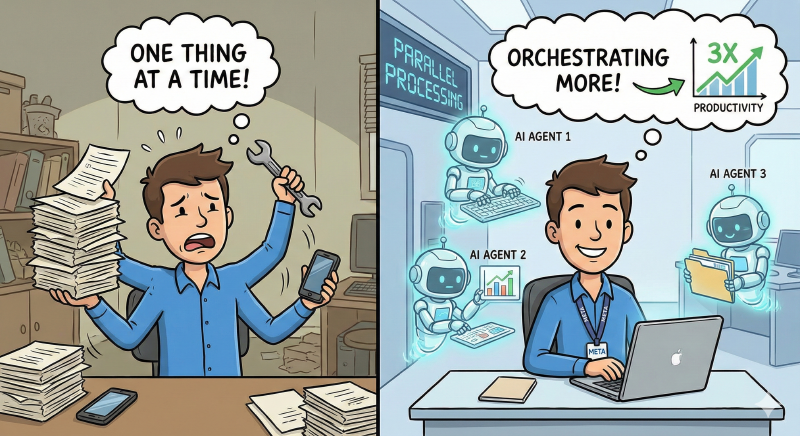
Multi-tasking has always been a challenge for human beings. No matter how many tasks we juggle, no matter how fast we work, at any single point in time, we can only do one thing. This feels natural, but it’s actually a massive bottleneck.
Because of this constraint, if a person wants to accomplish more, he/she typically needs to work longer hours. If a team wants more output, it needs to hire more people. In both cases, it comes with diminishing marginal utility.
AI changes this equation. With agents, multi-tasking becomes genuinely possible. We can delegate tasks to multiple agents running in parallel while we focus on what requires human judgement. This creates the potential for everyone to become a multiple of themselves — not by working harder, but by orchestrating more.
Knowledge Sharing #
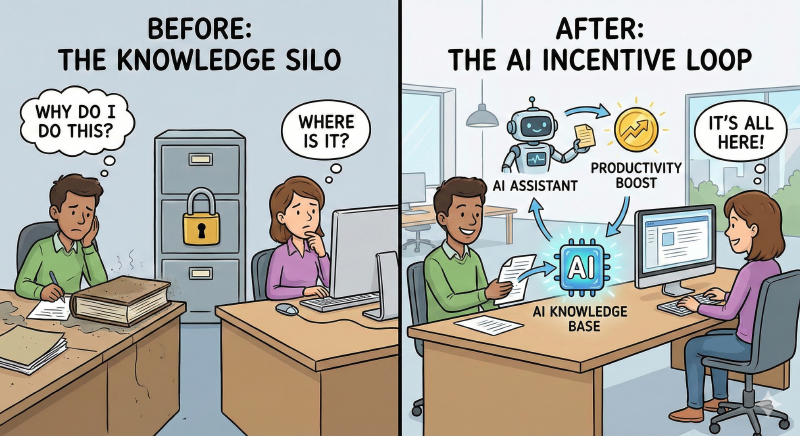
Knowledge sharing is critical to effective collaboration, but it’s much easier said than done. On the giver’s side, it takes time to document knowledge and keep it current. On the receiver’s side, it takes time to discover and absorb that knowledge. There’s also a motivation problem: why invest in documentation if it doesn’t directly benefit the author?
AI shifts this dynamic. I’ve observed much higher motivation for people to write down their knowledge when AI can pick it up, because it makes the AI more capable — which in turn brings further productivity boost back to the author. The incentive loop closes.
The result is an AI that has acquired knowledge that would take any individual much longer to learn on their own.
Resilience #
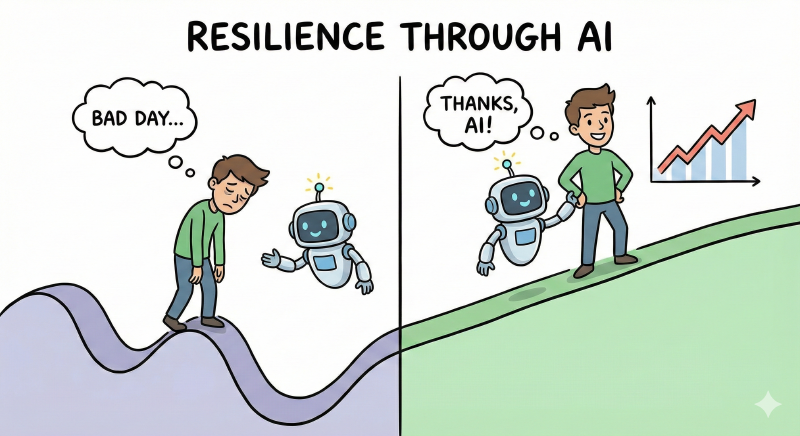
Human productivity is variable. We have good days and bad days — our energy, focus, and motivation fluctuate.
AI adds resilience to this system. When we’re not at our best, we can lean more heavily on AI to maintain output while we recover. When we hit a wall on a problem, AI can offer alternative angles. When context slips from memory, AI can reconstruct it. The effect compounds: our floor rises, and we recover faster from setbacks.
Cognitive Offload #
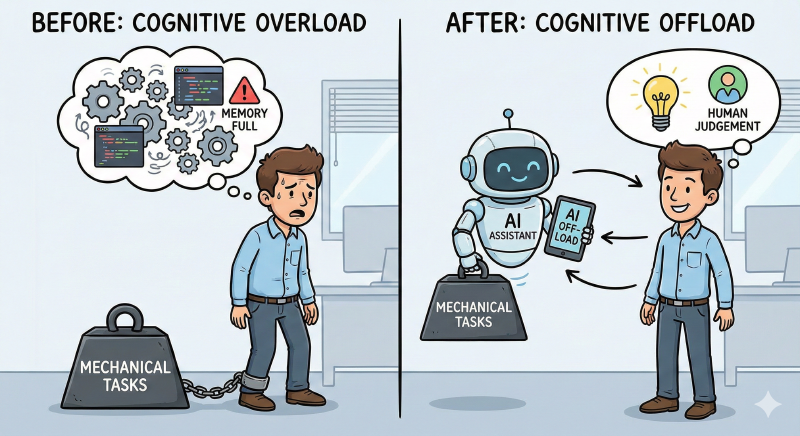
Some of the draining parts of engineering are mechanical: reading through unfamiliar code, tracing dependencies, holding context in your head, typing out implementations. These tasks all consume cognitive bandwidth.
AI excels here. It can read and comprehend a large codebase in seconds. It can produce code that would take a human minutes to type in moments. By offloading this mechanical work, AI frees our mental capacity for what actually requires human judgement: understanding the real problem, making design tradeoffs, and evaluating whether solutions fit the broader system.
Industrial Shift #
Beyond productivity boosts, there’s a more urgent reason to embrace AI: the industry itself is shifting, and we need to adapt.
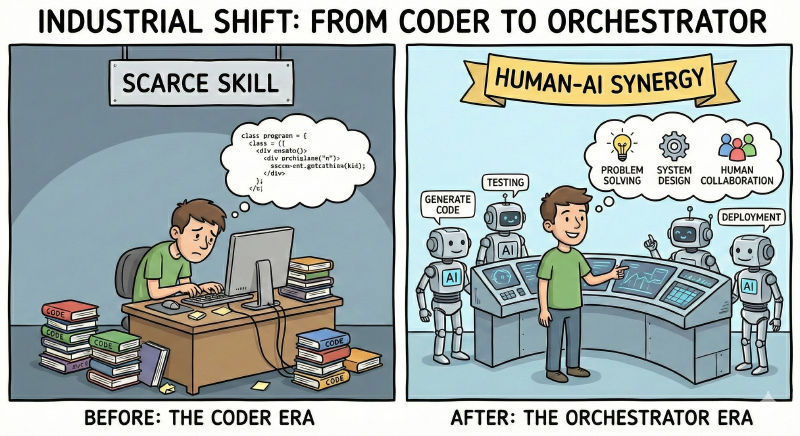
Coding, which was once a scarce and highly demanded skill (“All I need is a programmer”), has become cheap. AI is iterating rapidly, and it’s easy to imagine a near future where coding becomes accessible to everyone.
The implication is clear: the ability to write code alone is no longer enough to remain competitive in this profession. Engineers who rely solely on coding skills will find themselves in an increasingly disadvantageous position as AI becomes more capable.
The role of the software engineer is fundamentally transforming — from “coder” to “orchestrator”. This means spending more time understanding problems, decomposing them into components AI can handle, reviewing and refining AI-generated solutions, and collaborating with both AI and humans.
Conclusion #
It is a new era of software engineering. The engineers who thrive will be those who embrace AI as a partner: delegating where it excels, focusing where humans add unique value, and continuously improving how to orchestrate the two effectively.